Dan — Augusta Custom Clubs & Swing Analysis
Retired Professional Engineer | Certified Health Physicist | TPI Level 3 | Certified Clubfitter
After hundreds of lessons, thousands of club fittings, and countless hours studying the golf swing, one pattern keeps showing up: most golfers don’t need a complicated swing overhaul to hit better drives.
They need a better setup.
The driver is the most misunderstood club in the bag. Golfers are told to play the ball way forward, widen their stance dramatically, and consciously swing up on the ball. Those ideas create far more problems than they solve. When the ball is pushed too far forward and the stance is too wide, golfers tend to reach for the ball, open their shoulders without realizing it, lose the ability to rotate fully, and create tension where there should be freedom. The predictable result is a steep, across-the-ball path, inconsistent contact, excessive spin, and—more often than not—a slice.
There is a simpler way.
Three Setup Adjustments That Change Everything
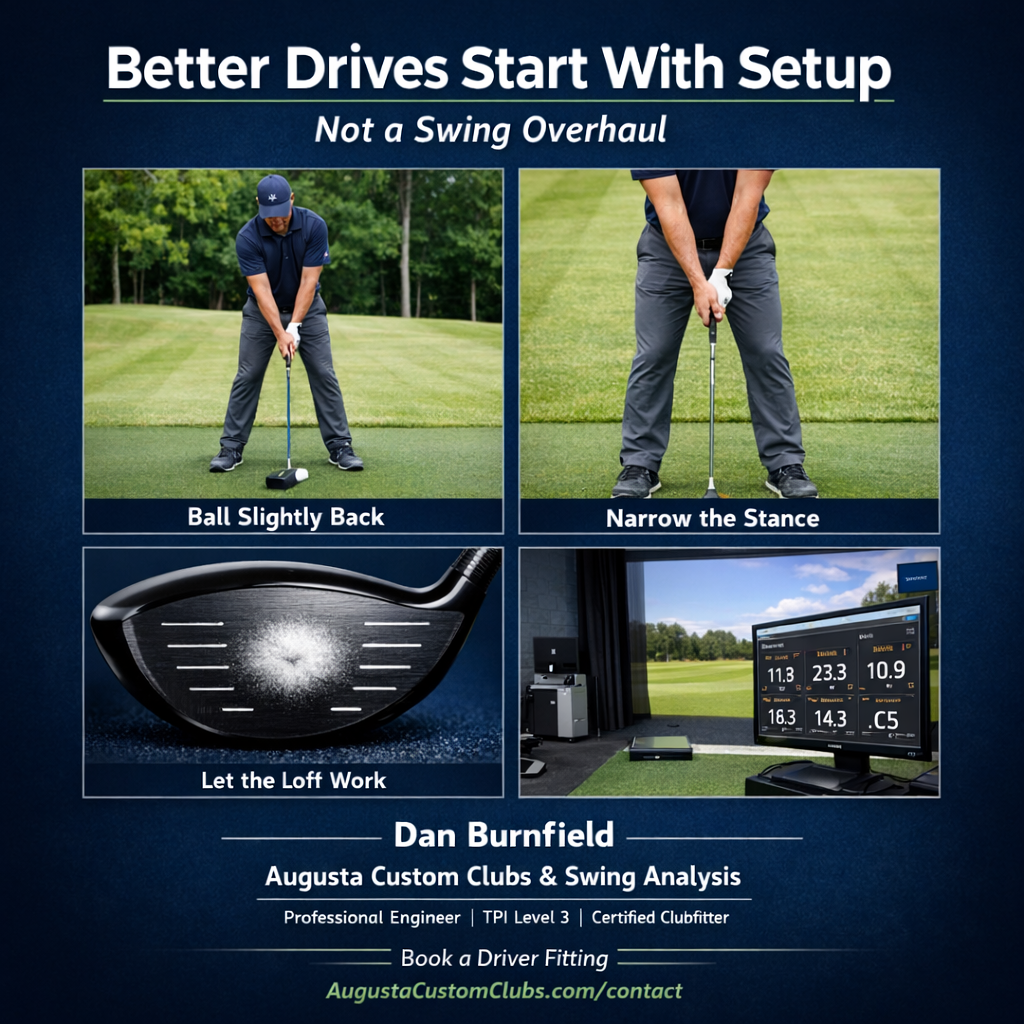
Move the ball back slightly. Not to the center of your stance—just away from the extreme forward position most golfers default to. When the ball sits too far forward, it becomes difficult to control low point and face delivery, which forces compensations late in the swing. A more neutral ball position lets the club arrive in a more natural part of its arc, delivering proper loft with better stability.
Narrow the stance. An overly wide stance restricts rotation and kills athletic balance. Bring the feet a bit closer together, and most golfers immediately feel a freer, more powerful turn. Better rotation means improved sequencing and more centered contact. This is not a dramatic change—just enough to let the body do what it naturally wants to do.
Stop trying to swing up on the ball. Consciously manufacturing an upward strike almost always backfires. It leads to excessive spine tilt, hanging back on the rear foot, and flipping through impact. Modern drivers are engineered to launch the ball efficiently, but that efficiency depends on correct loft for your swing speed and delivery—not on an exaggerated upward attack angle.
The Loft Most Golfers Actually Need
This is where engineering meets ego, and ego usually wins—to the golfer’s detriment.
Many players assume they need a 9-degree driver because that’s what they see on professional tours. For most recreational golfers, that loft is simply too low. When launch angle is insufficient, carry distance drops, spin characteristics suffer, and the result is a weak, falling trajectory that never reaches its potential.
Choosing a driver with more appropriate loft—10.5°, 11°, or even higher depending on swing speed—can produce immediate improvements in trajectory and overall distance without changing a single thing about the swing.
Understanding Launch Angle
Launch angle is influenced by several measurable and interrelated factors. Static loft—the actual loft built into the club—sets the baseline. Dynamic loft is the loft presented at impact, influenced by shaft lean, face orientation, and how the club is delivered to the ball. Spin loft, the difference between dynamic loft and attack angle, plays a critical role in determining both launch and spin characteristics.
Centered contact on the face matters enormously. Strikes low on the face reduce launch angle and increase spin, while centered contact stabilizes both. Tee height, ball position, shaft profile, and shaft flex all contribute to how the club presents loft at impact.
The important takeaway is that none of these factors require a conscious effort to swing upward. Better launch comes from correct equipment specifications paired with sound mechanics—not from manipulating the swing path.
What Actually Produces Distance
Distance with the driver comes down to three things: centered contact, efficient loft delivery, and a complete turn through the ball. Not one of these requires forcing an upward strike.
Use a driver with sufficient static loft for your swing speed. Set up with balanced, neutral posture so you can rotate fully. Tee the ball at an appropriate height and strike it near the center of the face. Allow your body to complete a full turn through the shot rather than manipulating the clubhead in an effort to lift the ball. When the correct loft is paired with centered contact and efficient rotation, the launch characteristics the club was designed to produce show up naturally.
What We See When Golfers Make These Changes
When golfers implement these simple setup adjustments, the improvements are remarkably consistent: more centered contact, a more neutral club path, improved launch consistency, and more reliable carry distance. The swing itself barely changes. The improvement comes entirely from placing the body in a position that allows the swing to function the way it was meant to.
If you struggle with slicing, inconsistent driver contact, ballooning shots, or loss of distance, start here. Move the ball slightly back from an extreme forward position. Narrow the stance just enough to free up your turn. Focus on making a full rotation rather than manufacturing an upward strike. And make sure your driver has enough loft for your swing speed.
Sometimes the fastest improvement doesn’t come from adding complexity. It comes from removing exaggeration.
Ready to Find Out What Your Driver Should Actually Be Doing?
At Augusta Custom Clubs & Swing Analysis, we use launch monitor data, 3D motion analysis, and precision shaft profiling to dial in the setup and specifications that actually match your swing—not someone else’s. Whether it’s finding the right loft, optimizing your shaft, or fine-tuning the setup fundamentals that make everything else fall into place, every recommendation is backed by measured data and over 30 years of fitting experience.
Book a driver fitting or swing analysis session and see the difference the right setup makes.
AugustaCustomClubs.com/contact