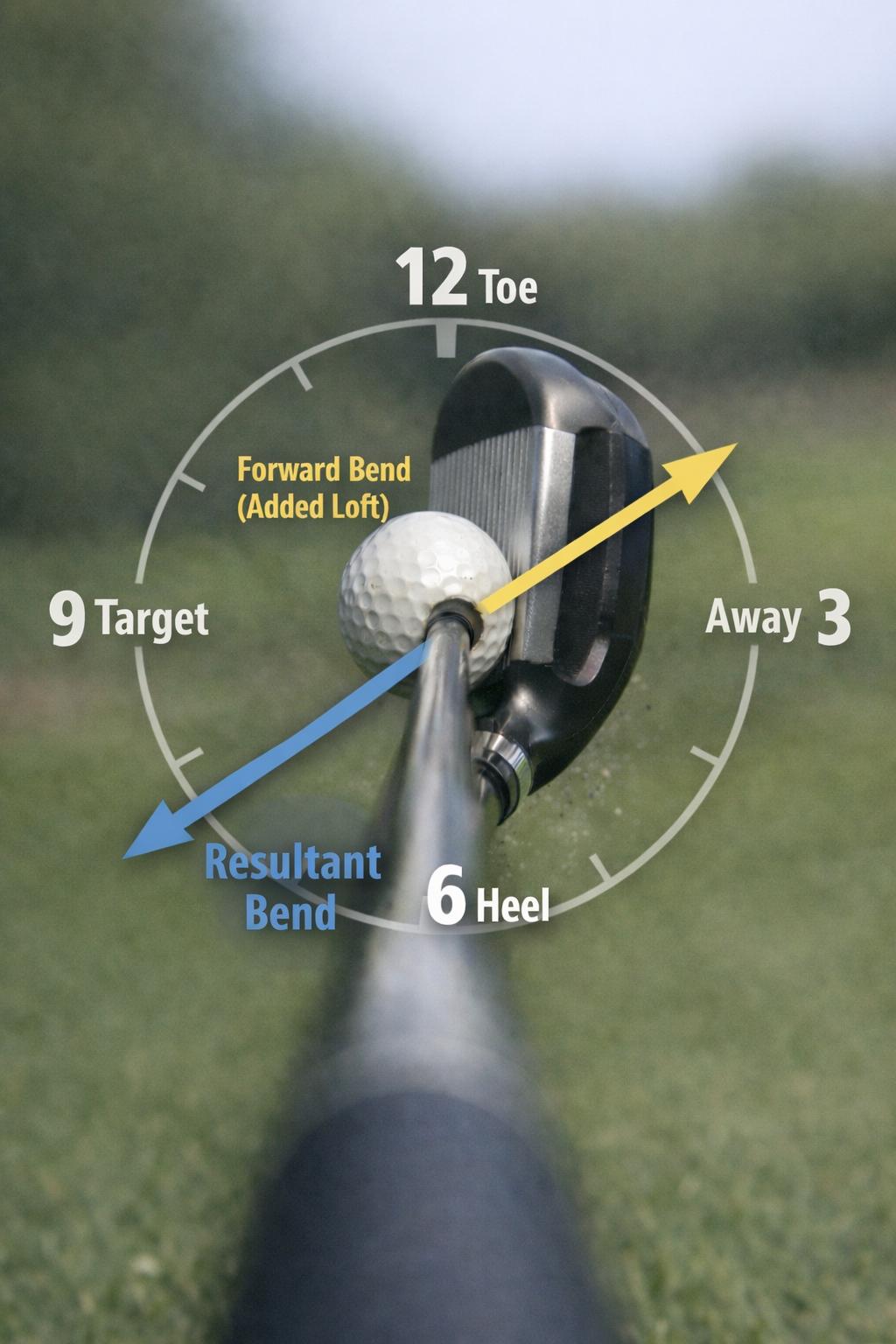
Shaft behavior is among the most misunderstood aspects of golf instruction and club fitting. Common terms such as “load,” “kick,” or “release” are frequently used, yet they seldom address the critical factors: the shaft’s shape and direction at impact. Explanations that emphasize feel or earlier swing motion often obscure the decisive moment that determines ball flight. At impact, the shaft is not straight. It is bent, measurably and predictably. That bend is not random, and it is not arbitrary. It occurs in a specific direction that can be clearly described when the reference frame is correctly defined. This article focuses exclusively on the shaft’s behavior at impact, excluding considerations of transition, downswing loading, energy storage, or post-impact recovery. The analysis is confined to the instant the ball contacts the clubface. The objective is to describe the shaft’s physical state at that moment in a manner that is precise, intuitive, and internally consistent. To achieve this, a clockface model is applied to the shaft as viewed directly down its axis. When properly defined, this clockface provides an effective and unambiguous framework for describing shaft bend.
The Fixed Reference Frame
A fixed reference frame is essential for any meaningful discussion of shaft behavior. Many errors in shaft explanations arise from minor changes in the reference frame between statements. For this model, the reference frame is defined as follows: The observer’s viewpoint is directly down the shaft from the grip toward the clubhead. The clubface is square to the target line. The clubhead path at impact is assumed to be down the target line. This final assumption is intentional. The model is designed to describe shaft deformation at impact, rather than to analyze face-to-path relationships or swing plane geometry. Assuming a neutral path isolates shaft bending from other variables. Once established, this reference frame remains constant throughout the analysis.
The Correct Clockface (Right-Handed Club)
With the viewpoint fixed, the clockface is referenced to the club and target line, rather than to the golfer’s body or any camera angle. For a right-handed club viewed straight down the shaft at impact, the clockface is defined as follows: Twelve o’clock points toward the toe. Six o’clock points toward the heel. Three o’clock points toward the target. Nine o’clock points away from the target. All subsequent directional statements utilize this clockface definition, with no exceptions or rotations.
What the Shaft Is Doing at Impact
At impact, the shaft is bent. More specifically, it exhibits a linear bend resulting from two dominant components that are always present at impact in a full swing. Those two components are: • Forward bending toward the target • Lateral bending toward the heel On the clockface, this means the shaft is bent somewhere between 9 o’clock and 6 o’clock at impact. This diagonal direction is not theoretical or interpretive; it is the necessary result of a flexible beam supporting a mass under impact loading.
Forward Bending at Impact (9 o’clock)
The first component of shaft bend at impact is forward bending toward the target. On the clockface, this is toward 9 o’clock. At impact, the clubhead has overtaken the handle. The shaft is elastically deflected forward, placing the clubhead slightly ahead of where it would be if the shaft were rigid. This forward deflection directly contributes to the delivered loft. This point warrants explicit and unqualified emphasis: Forward shaft bending always increases delivered loft. It never reduces loft. There is no mechanism by which elastic shaft bending can subtract loft below the club’s static loft at impact. What changes with swing speed is not the sign of the effect, but its magnitude. Higher swing speeds produce greater forward bending and, therefore, more added loft. Lower swing speeds produce less forward bending and therefore less added loft. But the contribution is always positive. Dynamic loft, therefore, is not exclusively a function of hand position or shaft lean. The shaft itself always adds loft through forward deflection at impact.
Lateral Bending at Impact (6 o’clock)
The second dominant component of shaft bend at impact is lateral bending toward the heel. On the clockface, this is toward 6 o’clock. In this model, both the toe of the clubhead and the tip of the shaft move toward 6 o’clock at impact. This is a critical clarification. This lateral movement is often referred to as “droop,” although this term is frequently misapplied. The key element is the direction of motion and deformation, rather than the terminology used. At impact: • The toe of the clubhead moves toward 6 o’clock • The tip of the shaft also moves toward 6 o’clock That means the lateral component of the shaft bend at impact is heel-ward, not toe-ward. This lateral deflection alters the delivered lie relative to address. It does not require the toe to be lower than the heel at impact. It only requires that the toe be lower relative to its address position. Static lie angle and setup still determine absolute orientation.
Why the Shaft and Toe Move Toward 6 o’clock at Impact
Lateral bending toward 6 o’clock is neither accidental nor indicative of a swing fault; it is a required physical response. At impact, the clubhead has mass and is being forced to follow a curved path. To remain on that path, it must experience inward (centripetal) acceleration. The reaction to that inward acceleration is an outward load at the clubhead. Because the clubhead’s center of mass is offset from the shaft axis, that outward load produces a bending moment that displaces the shaft tip down. Within the defined reference frame, this displacement is directed toward 6 o’clock. The clubhead and shaft tip move together in that direction as part of the same physical system responding to impact loading.
The Resultant Bend Direction at Impact
Because forward bending toward 9 o’clock and lateral bending toward 6 o’clock occur simultaneously, the shaft is not bending along a single axis at impact. It is bending diagonally. In clockface terms, the resultant shaft bend direction lies between 9 o’clock and 6 o’clock. This diagonal direction fully describes the shaft’s dominant linear bending state at impact. A bend closer to 9 o’clock indicates dominant forward deflection with relatively little lateral movement. A bend closer to 6 o’clock indicates stronger lateral deflection with relatively less forward deflection. Most real-world impacts occur between these two extremes.
Magnitude and Direction Both Matter
It is not sufficient to discuss only how much the shaft bends, nor is it sufficient to discuss only the direction of the bend. Performance differences arise from both the magnitude and direction of bending. Magnitude determines how much loft is added and how much delivered lie changes relative to address. Direction determines how that bending expresses itself spatially at impact. Swing speed predominantly determines magnitude. Impact loading geometry determines direction. Both factors are simultaneously present and both strongly impact performance.
What Shaft Design Can and Cannot Do
Under USGA rules, shafts must be axis-symmetric. They are not permitted to bend in one lateral direction over another. Shafts do not “choose” a direction of bend. They respond elastically to applied loads. Differences between shafts show up primarily as differences in: • Overall stiffness and stiffness profiles • How much they bend under a given load • How consistently they respond to impact forces They do not show up as intentional directional bias in bending. Any explanation that suggests a shaft is designed to favor heel-side bending over forward bending, or vice versa, is inconsistent with both the rules and basic mechanics. Under USGA rules, shafts may not be oriented in a way that deliberately influences ball flight. In practical terms, this means that when a shaft is Pured, FLO’d, or spined, any preferred orientation must be aligned only along the 3–9 o’clock axis or the 12–6 o’clock axis. These orientations are orthogonal to the resultant bending direction at impact, ensuring that shaft orientation does not bias the bending direction.
Why Impact Is the Only Moment That Matters
From a performance standpoint, only one instant matters: impact. Shaft behavior earlier in the swing is only relevant if it influences the shaft’s shape and orientation at impact. By focusing exclusively on impact, this model avoids debates regarding swing style, release patterns, or player intent. At impact: • The shaft always bends forward toward the target. • The shaft always bends down toward 6 o’clock in this reference frame. • The shaft always increases delivered loft and decreases lie angle. The only questions are: How much does it bend?a Where between 9 and 6 o’clock does the resultant bend lie? Once these questions are addressed, shaft behavior at impact can be clearly understood.

